
THE WASHINGTON WEST WHAT'S GOING ONS

LOCAL

ISSUE

33

1 PAGE

PHILLY

AUG-2026 (1)

LOCAL

ISSUE

33

1 PAGE

PHILLY

In front of a local water station in Asikuma, Ghana

Foreign Correspondent Returns

Diligently bringing the updates nobody asked for

Alex Hoffman

After many many months, WWWGO is making a return. My hiatus was due to lacking the motivation and time, in that order, to write up much of anything, even through major life events like moving in with Katie and others that don’t come to mind. For the next month I am forcing myself to overcome this lazy attitude, and with good reason.

I am spending August on a work fellowship in Ghana supporting a safe water NGO to standardize their operations and quantify the impact their water has on communities. The fellowship began with a week in Johannesburg training on global health, cultural competence, and asking questions. There are teams from all over the world going to support NGOs across Africa, South America, and Asia, so there was a lot of small talk Olympics as well. For those who know me, which is all eight of you, you know this is my worst nightmare, but the people were interesting and among the nicest I’ve ever met, so I think I made my country proud with my performance. Throughout the week my nervousness to speak 1:1 with a stranger melted away. In a world of sepaku-inspiring corporate trainings, this one was engaging, energizing, and fun. Truly a masterclass by all involved.

Over the next month I will do my best to use this as a way to record my thoughts, feelings, and observations. There may be less talk of poop and crap than usual, although that is never far from my mind. For professional updates, please see my company mandated LinkedIn posts. When you read those, just know they were posted with a feeling of embarrassment deep in my stomach. We will be moving between Accra, where our apartment has a rooftop pool and penthouse gym with floor to ceiling windows, and rural villages where running water and power is never guaranteed.

Many (one person) have been beating down my door about when the newsletter will return, so I am listening to the heartbeat of the people. This is for you. You know who you are (it’s Colm and he asked twice).

Driving on National Highway 1

Mad Max Fury Road

Thumping 60 miles in 3 hours

Alex Hoffman

Early on the second day we set out on a four day trip journeying three hours inland. The first hour was all Accra. We moved through intersections without lights or lane markers where drivers stop, turn, and drive when they please in a universally understood system. One beep of the horn tells someone you’re going and they need to make room. It also says you’re passing or changing lanes. That same tone carries translations that all local drivers know the nuances of. To me in the passenger seat, it is a thrilling song and dance where cars get impossibly close to other drivers, motorbikes, and pedestrians crossing the free way. Along the road vendors pile food, water, and Temu products atop their heads and move between the cars. Here, a beep is also a sign that they have a customer waiting.

As we moved out of the city the definition of a lane blurred, physically and societally. Once we climbed the mountain separating Accra from the rest of the country, where mansions sat with a smoggy vista of the city’s sprawl, the already rare road markings vanished completely. Here, a two lane road became three, a three lane road became five. Drivers put their car anywhere there was room, and a few places there wasn’t.

In a snap the car moves from the far right to the far left with a truck coming right at you. One moment later you’re even further right riding the dirt shoulder with a motorbike so close it is almost inside the car and there’s a 50% chance it is driving the wrong direction. All of this is to avoid frequent potholes that somehow do not come close to the size of those in Philly. Cherelle Parker strikes again. At points along the ride, our 4x4 pickup truck became critical as the pavement gave way to rocky dirt, only to come right back a few minutes down the road.

Lining the street, which is heavily trafficked since it connects Accra to Africa’s largest manmade lake, Lake Volta, are local markets bustling with people selling clothes, phone cases, food, and just about anything else; independently operated buses, which are vans filled to the brim with people and so much cargo that trunks are bungied closed and sacks are strapped to the roof; billboards advertising funerals; frequent construction crews widening the road, and police checkpoints where they collect money from occasional victims. Several times the bumpiness pulled me towards sleep, only for a sudden movement to jerk me awake. Our driver, Daniel, knew the road intimately. His mind was a map of every pothole and speed bump. As a result, with closed eyes you had no way of knowing if your next movement would be left, right, forward, backward, up, or down. This was often the case with open eyes as well. From behind it looks like a cartoon portrayal of a drunk driver as the car makes sweeping swerves across the entire width of the road and beyond. Only Daniel knew what was next and he kept that a closely guarded secret, since we did not speak much. The silence was cut by a local radio station playing American R&B. Frequent interjections that would cut the music mid verse for the radio host to call us baby, darling, and honey in a voice much too sexy for the morning show. She said she wanted to get to know us, and I really believe her. After three hours of willing away motion sickness we pulled up a small side road predominantly made of loose rock and Daniel eased the car to a stop in front of our destination. At times the odds seemed slim, but we made it. The good news was we had four days until we had to make the drive back.
The Chief’s Council

Meeting with village royalty

Alex Hoffman

Our meeting with the Asikuma village elders was set for 10 am, but everyone expressed the importance of arriving early — a rare departure from the Ghanaian culture of starting late. The chief should not be kept waiting. In nervous obedience, we arrived at the meeting point just after 9 am and began the preparation. This involved drafting questions, discussing customs, and fetching two bottles of Oris London Dry Gin as a gift. This last piece is non-negotiable. You will not get a meeting without it.

When the time came we filed into what I later learned was the royal palace. We sat outside on plastic chairs as goats, chickens, and kittens roamed around us. One by one the elders arrived until all ten of them were there. Sitting across the concrete patio, I was struck by how normal they all looked. Car keys dangled from their hands. One was wearing double knee denim shorts and a polo. Another, decades younger than the others, wore a pink cut off and answered texts from a phone with a Chicago phone case. Their presence felt approachable, but it was clear they held sway. It was also clear who was most important. Seven chairs sat on their side and when a more senior person arrived, a junior attendee would quickly vacate their seat to make room.

The meeting followed their formal customs. We introduced ourselves and formally requested a council. They approved quickly. We were there to talk about safe water — a topic that weighs heavily on their minds. It was at this point that we learned each of their roles. The men across the floor introduced themselves as chief, chief regent, youth leader, linguist, and war lord, or which there were two. Meeting with local war lords was unexpected, but seeing as the area is remarkably peaceful, there was no cause for concern. The youth leader lived up to the title by immediately offering me a wife if I was willing to stay. In fewer words, I told him I signed a two year lease and had a good thing going on back home. He seemed to understand, but left the door open. I never got to meet the lucky bride to be, but I have a sneaking suspicion she would not have been age appropriate.

When we began asking questions, through a Twi translator, they answered with candor. The responses were eye-opening. They painted a picture of a years long water crisis in the area. The government supply stopped one day and was never restored. An NGO dug them a well, but the salty water faded their clothes, hurt their skin, and was undrinkable. Next, they turned to a road side drainage ditch. People got sick, developed ulcers, and had frequent headaches. Nurses and teachers were hesitant to move there because word had spread about the lack of water. Then, our NGO brought safe water to their homes. Illnesses faded away, children missed less school, investors brought new business, and critical professions began to move in. The economy of the community shifted. One of the war lords spoke for the first time. He said things were 95% better, and they were eager to reach 100%. His hope was for every household to have a water tap in their home. That made it clear how much we take for granted. His dream for the village is something we treat as the bare minimum.

With that vision established, the meeting came to a close after more than an hour. We had to formally request their permission to end the meeting. Then, the gin came out. The palace linguist cracked the seal and filled a small glass to toast to our partnership, which he attempted to hand to the chief regent, but it dropped and shattered across the patio. While he swept it up with a flip flop, the chief stormed off in frustration. Someone fetched a new glass and the regent said a prayer in their native language. With each sentence, he splashed gin onto the concrete as an offering to the ancestors. When the glass was empty and the ancestors had had their fill, the linguist grabbed back the glass and walked towards me. He handed me the refilled glass and gave a set of instructions in Twi. When I stared at him blankly, he repeated in English, “drink a small sip, then pour.” I obliged and the taste of my breakfast was replaced by the stinging of gin. Collegiate instincts kicked in and I kept a straight face as I poured the rest on the ground for the ancestors who had sat there before. Each attendee repeated this act, with some of the local men stretching the “small sip” instruction by drinking the entire glass. With the ancestors sufficiently drunk, we shook hands and gave a final thanks and goodbye to them and my mystery bride.

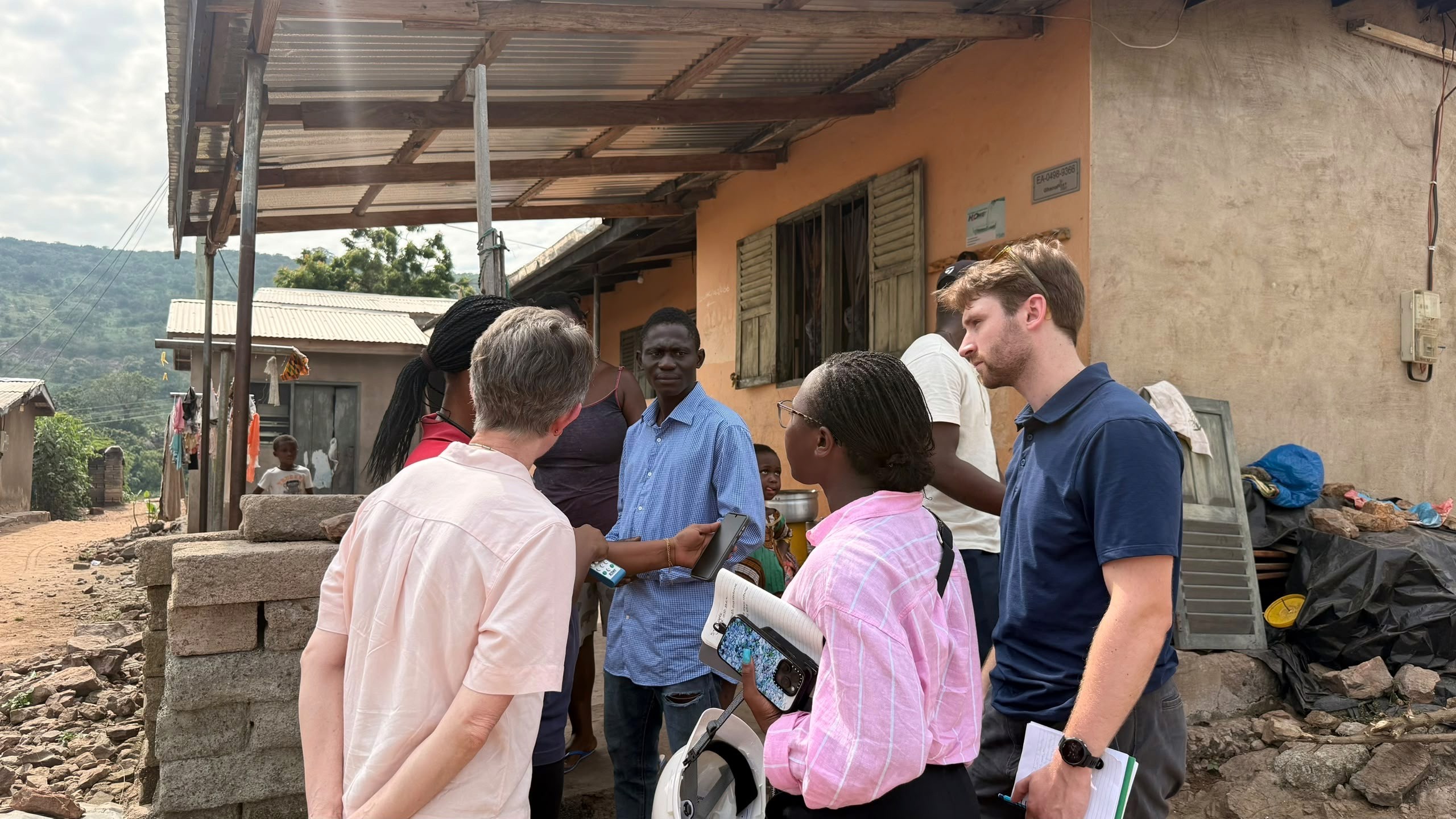
Meeting with a water customer in the area

The Chief’s Council

Meeting with village royalty

Alex Hoffman

Our meeting with the Asikuma village elders was set for 10 am, but everyone expressed the importance of arriving early — a rare departure from the Ghanaian culture of starting late. The chief should not be kept waiting. In nervous obedience, we arrived at the meeting point just after 9 am and began the preparation. This involved drafting questions, discussing customs, and fetching two bottles of Oris London Dry Gin as a gift. This last piece is non-negotiable. You will not get a meeting without it.

When the time came we filed into what I later learned was the royal palace. We sat outside on plastic chairs as goats, chickens, and kittens roamed around us. One by one the elders arrived until all ten of them were there. Sitting across the concrete patio, I was struck by how normal they all looked. Car keys dangled from their hands. One was wearing double knee denim shorts and a polo. Another, decades younger than the others, wore a pink cut off and answered texts from a phone with a Chicago phone case. Their presence felt approachable, but it was clear they held sway. It was also clear who was most important. Seven chairs sat on their side and when a more senior person arrived, a junior attendee would quickly vacate their seat to make room.

The meeting followed their formal customs. We introduced ourselves and formally requested a council. They approved quickly. We were there to talk about safe water — a topic that weighs heavily on their minds. It was at this point that we learned each of their roles. The men across the floor introduced themselves as chief, chief regent, youth leader, linguist, and war lord, or which there were two. Meeting with local war lords was unexpected, but seeing as the area is remarkably peaceful, there was no cause for concern. The youth leader lived up to the title by immediately offering me a wife if I was willing to stay. In fewer words, I told him I signed a two year lease and had a good thing going on back home. He seemed to understand, but left the door open. I never got to meet the lucky bride to be, but I have a sneaking suspicion she would not have been age appropriate.

When we began asking questions, through a Twi translator, they answered with candor. The responses were eye-opening. They painted a picture of a years long water crisis in the area. The government supply stopped one day and was never restored. An NGO dug them a well, but the salty water faded their clothes, hurt their skin, and was undrinkable. Next, they turned to a road side drainage ditch. People got sick, developed ulcers, and had frequent headaches. Nurses and teachers were hesitant to move there because word had spread about the lack of water. Then, our NGO brought safe water to their homes. Illnesses faded away, children missed less school, investors brought new business, and critical professions began to move in. The economy of the community shifted. One of the war lords spoke for the first time. He said things were 95% better, and they were eager to reach 100%. His hope was for every household to have a water tap in their home. That made it clear how much we take for granted. His dream for the village is something we treat as the bare minimum.

With that vision established, the meeting came to a close after more than an hour. We had to formally request their permission to end the meeting. Then, the gin came out. The palace linguist cracked the seal and filled a small glass to toast to our partnership, which he attempted to hand to the chief regent, but it dropped and shattered across the patio. While he swept it up with a flip flop, the chief stormed off in frustration. Someone fetched a new glass and the regent said a prayer in their native language. With each sentence, he splashed gin onto the concrete as an offering to the ancestors. When the glass was empty and the ancestors had had their fill, the linguist grabbed back the glass and walked towards me. He handed me the refilled glass and gave a set of instructions in Twi. When I stared at him blankly, he repeated in English, “drink a small sip, then pour.” I obliged and the taste of my breakfast was replaced by the stinging of gin. Collegiate instincts kicked in and I kept a straight face as I poured the rest on the ground for the ancestors who had sat there before. Each attendee repeated this act, with some of the local men stretching the “small sip” instruction by drinking the entire glass. With the ancestors sufficiently drunk, we shook hands and gave a final thanks and goodbye to them and my mystery bride.

Meeting with a water customer in the area

Balancing Act

Balancing Act

Record set for most food balanced on head. It’s more than you think.

Record set for most food balanced on head. It’s more than you think.

Chaos on the Freeway

Chaos on the Freeway

Construction turns national road to 90% dirt, 10% rock.

Construction turns national road to 90% dirt, 10% rock.

Stretching Time and Space

Stretching Time and Space

“5 minutes” said man before 30 minutes of off-roading.

“5 minutes” said man before 30 minutes of off-roading.

WASHINGTON WEST

WHAT'S GOING ONS

WASH

SQUARE

WEST

WHAT'S

GOING

ONS

Create a free website with Framer, the website builder loved by startups, designers and agencies.